My daughter, who is sixteen, has always been a challenging child – in the best possible way. She challenges everyone she meets, whether in real or cyber-space, on matters of all kinds, but saves the toughest tests for me. She lets me get away with nothing and generally saves her most challenging questions for when I go to kiss her goodnight or, when she was a little girl, as I was about to read her bedtime story. On one such evening some eight years ago she opened with:
“So Daddy, this Logotherapy thing that you go to Jo’burg to learn, what’s it all about?”
Having just started my studies and, hoping to keep the conversation simple, I responded: “Well, it’s all about finding meaning and purpose in life.”
“Hmmm. That sounds interesting. And who invented Logotherapy? “
“A man by the name of Viktor Frankl.”
“That’s a funny name. Where did he live?”
“In Austria.”
“That’s far. And when did he invent Logotherapy?”
“About 90 years ago, in the 1930s.”
“So, before 90 years ago there was no meaning and purpose. And after that, only for people in Austria?”
At this point I realised I had better settle in for one of our longer conversations and put aside the story book from which I had planned to read.
“Well, no, not really–“
“So then how did people know about stuff like meaning and purpose before Logotherapy was invented? Especially cavemen who were a very long time ago?”
I grappled for a moment – and my eye fell on the story book.
“Well… they learned about meaning and purpose through stories.”
“But cavemen couldn’t read or write.”
“You’re absolutely correct, they couldn’t. But they shared stories.
“You mean like they sat around fires and stuff telling each other stories?”
“That came a bit later. We call that Oral Tradition. Or they acted them out. Like you’ve seen in the theatre.”
“But they didn’t have theatres, Daddy! No stages, or scenery or lights or costumes…”
“Right again, they didn’t. But theatre doesn’t need all those things. All it takes for theatre to happen is a space and two people, one to tell the story and one to watch and listen to it.”
“So… theatre has always been there? Just like stories?”
“Well, certainly ever since we evolved sufficiently to be able to think creatively and imaginatively, yes.”
“Okay. But I still don’t get how cave people knew about meaning and purpose through stories and theatre.”
“Perhaps they didn’t know about them consciously. But… think about the rock paintings you’ve seen. What do they show?”
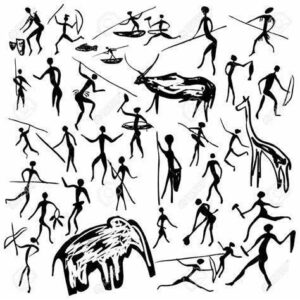
“Well, one I can remember shows a man killing a huge animal with a spear.”
“Right. So that man would probably have been a dad right? And the huge animal, the food he was hunting for his family. And once he got back to their cave and after the family had eaten some of the animal he had hunted, maybe the dad told the mom and children a story about his hunt.”
“Ja, like maybe the animal tried to trample him to death before he managed to kill it.” (She has always had a taste for the gory).
“Exactly! Great story to share! But did he allow that danger to make him scared and run away from the hunt?”
“No! He had to carry on, even though he may have been hurt, and be brave so his family could eat.”
“Yes! So he was fulfilling a purpose, right? He faced challenges like fear and physical pain. But he had to overcome those because he knew he had to take on the responsibility to fulfil his purpose by doing what gave his life meaning – providing for his family.”
“And because he did that and, after the mom and kids listened to the story, the dad was their hero.”
“Good thought. Which might have inspired them to want to live heroically too, even if it was difficult, right?”
“And is that what you are learning to do, Daddy? Teach people to live like a hero even if it’s hard?”
“Well, it’s a little bit more complicated than that, but pretty much so, yes.”
She thought deeply for a few seconds.
“So, the Viktor guy with the funny surname was actually a bit of a liar, hey.”
“How so?”
“He didn’t invent Logotherapy. It’s always been there! Because of stories and theatre.”

I share this anecdote, not because it contains any earth shattering revelations, but because it reminds us that young children are fully cognizant, on a simple level, of the fact that we as human beings have everything we require within us to live meaningful and purposeful lives. Inside our noetic dimension exists that wonderful fountain of all that connects us with ourselves, others, life, the universe and our unconscious and / or conscious God – our imagination. An imagination which is capable of supplying us infinitely with all we need in order to live creatively.
However, that fountain, as we grow into adulthood, maturity and ‘wisdom’ – recedes ever further and further from our reach. It never dries up; it always exists, but our access to it becomes blocked by the lies we are told, the wrong choices we make in believing those lies, and by the very process of living which is, in fact, not living at all. And most of us arrive early on at a point in our development at which imagination and creativity are relegated to the lowest rung on our life skills ladder, while we get on with the ‘real business’ of life. And the more we ‘get on’ with ‘getting on’, the denser the blockage to the real fountain of life becomes – until we forget it exists. And then we rush off to pay other people, who are sometimes equally unaware of their fountains, large amounts of money to tell us where we are going wrong. And if someone happens to suggest that we should rather look within, to our imaginative, creative selves, our response (unless we consider ourselves to be ‘artistic’ in some way) is a scoffing or dismissive “I don’t have a CREATIVE BONE in my body.”
“I don’t have a creative bone in my body”.
Of all the lies we tell ourselves about ourselves, this is one of the greatest. Of course, if we were to be pedantic, it would be the truth because obviously a bone cannot be creative. But, because we are naturally imaginative, we accept that the bone is a metaphor for the creative spirit, even in the very moment of denying possessing so much as an ounce of creativity. And in that moment we are not lying, we believe utterly that it is the truth, because we cannot feel it; the access to that fountain of creativity is so densely blocked, that we have completely forgotten it exists within us, buried under all the getting on with life we are so busy with – and by what I believe to be one of the greatest ‘plagues’ of our current millennium: OVERWHELMEDNESS.
In my practice I hear one phrase more than any other: “I am feeling totally overwhelmed.” This is hardly surprising. Never before have we been faced with so many choices on multiple levels. In the fast-paced landscape of the 2020s, we are consistently bombarded by a barrage of visual and aural stimuli. The rapid advancement of technology has led to a constant influx of information overload, blurring the boundaries between work and personal life as well as atrophying our creative and imaginative spiritual muscles.
Six months ago, most of us had barely registered AI other than in the context of science fiction. Now we are hearing on an almost daily basis of real jobs held down by real people which are being taken over by machines which can replicate and even surpass our practical functionality. Social media platforms, while offering connectivity, cause constant comparisons between our own lives and those of others, leading to feelings of inadequacy and envy. The pressure to stay informed, succeed professionally, and maintain a fulfilling personal life create perfect storms of stress and anxiety. Paradoxically, the spiritual tools which provide relief from this stress and anxiety become increasingly inaccessible as access to the noetic dimension, where the tools of healing reside, is blocked by the very conditions for which we require that healing. And so the vicious cycle is created.
How do we break this cycle? Where do we turn to release ourselves from this deadlocked way of life? One possibility is for us to turn to our CREATIVE BONE. But, what of the so many who dismiss that bone as being non-existent within themselves? Or those who may acknowledge its existence, but do not know how to access it? Or who are simply, through lack of practice, too uncertain or even scared to approach it for what it has to offer? Who or what can supply the key which will unlock that seemingly impenetrable door to the place in which the solutions and answers lie?

“All the world’s a stage,
And all the men and women merely players;
They have their exits and their entrances,
And one man in his time plays many parts…”
From William Shakespeare’s As You Like It.
“Life’s but a walking shadow, a poor player
That struts and frets his hour upon the stage
And then is heard no more.”
From Shakespeare’s Macbeth.
Theatre. Stories. Actors. All of which have been around for thousands of years. All potential keys. So why does Shakespeare paint such a negative picture of the actor as metaphor for the human being involved in the struggles of daily life? Well, he doesn’t. Because, as in any great art, context is all. In the first extract the words are those of Jacques, probably Shakespeare’s most cynical of his characters, who could be described as being trapped in Viktor Frank’s Existential Vacuum. For Jacques, humans as a species have no freedom or Will to Meaning and so he likens them to actors (“merely players)”, whom he further reduces to puppets whose strings are manipulated only by Fate – and never controlled by Choice.
In the second extract, Macbeth reduces humanity to “poor players” who are granted a brief, meaningless moment on the stages of their lives before fading into oblivion. But Macbeth is a man who has sacrificed his Will to Meaning on the altar of “vaulting ambition”, turned his back on his unique calling and responsibility to meaning and purpose in favour of a meaningless fleeting moment of abused and abusive power. At the beginning of the play, as a man of honour and integrity, he would have been more likely to describe humanity in the vein of another of Shakespeare’s characters, Hamlet, who says:
“What a piece of work is man, how noble in reason, how infinite in faculties, in form and moving how express and admirable, in action how like an angel, in apprehension how like a god.”
That same Hamlet who exhorts a troupe of actors to:
“Suit the action to the word, the word to the action, with this special
observance, that you o’erstep not the modesty of nature. For anything so
overdone is from the purpose of playing, whose end, both at the first and now, was and is, to hold, as ’twere, the mirror up to nature…”
What Shakespeare is saying is that a human being, if they live responsibly and meaningfully, can become almost godlike. He likens such humans to a great actor who plays their role with the goal of rising to the challenge, of accepting responsibility for fulfilling their ultimate purpose which is to “hold the mirror up to nature”. To be the reflections and champions of Truth.
Actors, as the interpreters of these stories, in their training under mentors and in their careers as performers under the guidance of directors, are on a continually transformative journey of self-discovery as they learn and develop the skills which liberate the Self from tension, stress, and anxiety. This is essential for allowing intuition and instinct to take centre stage in their creative expression in training, rehearsal and performance processes. By honing techniques which enable them to break through inhibitions and be fully present in the moment, actors unlock a wellspring of authenticity and meaning that brings characters to life. These skills, honed through rigorous practice, have the potential to serve as invaluable tools for individuals not engaged in artistic pursuits who are seeking liberation from stress, anxiety, and OVERWHELMEDNESS. Just as the actor uses tools to unlock and / or unblock access to their noetic dimension where their imagination and creativity – their CREATIVE BONE – resides, so can we all, through the acquisition and development of these tools, achieve this goal in our daily lives.
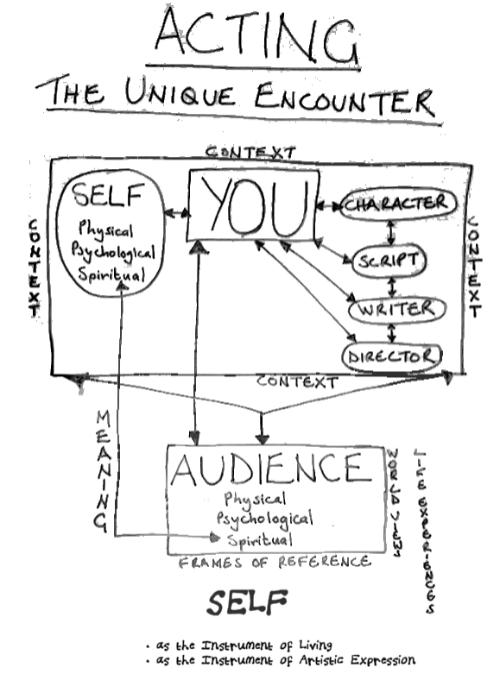
Furthermore, storytellers in the guise of writers, directors and actors, can serve as profound guides in the journey of understanding and navigating life’s complexities. By delving into the intricacies of human experiences, they “hold a mirror up to nature,” reflecting the emotions, dilemmas, and triumphs that define our existence. They offer us a lens through which to examine the uniqueness of our own lives, enabling us to connect with characters and situations that resonate with our own. As we witness characters surmount challenges, grapple with moral dilemmas, and evolve in response to their circumstances, we gain insights into the human psyche in general, and our own, in particular. These insights, in turn, become tools for more successful living, offering us guidance in making decisions, managing relationships, and embracing personal growth. Storytellers gift us not only with narratives but also with the wisdom to enrich our own life stories; to find meaning and purpose in the events of our lives.
Uniquely modified and applied developmental processes of actors and storytellers are the essence of LOGOTHEATRE, a term I coined during my Advanced studies which refers to the synergies between the philosophies, principles and techniques of Logotherapy and Acting / Theatre, and the potential for each to enhance the other’s processes and outcomes. Logotherapeutic processes can potentially develop better, more insightful Actors and Directors. Acting processes have the potential to empower Logotherapists to deepen their clients’ journeys towards discovering meaning and purpose through ever-evolving creative and stimulating methods, as well as the development of the Therapist’s own vocal, emotional, observational, improvisational and interpretive skills.
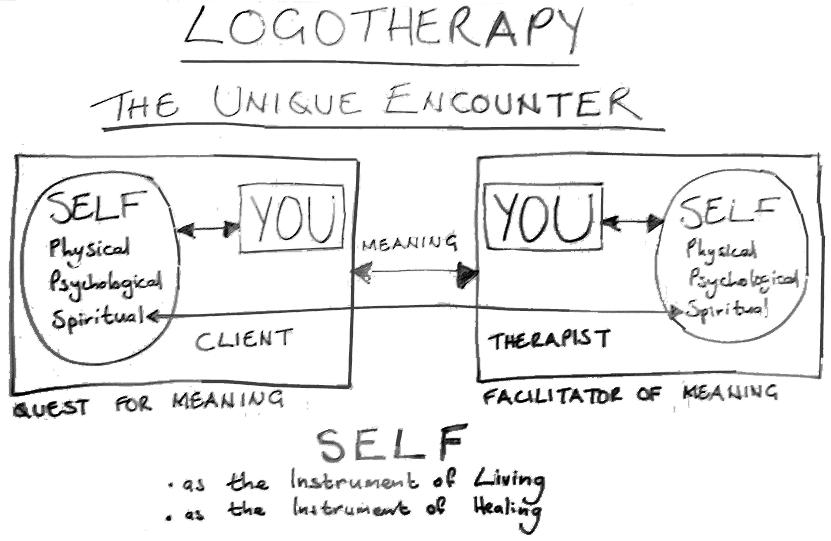
The COURSE IN LOGOTHEATRE offered through the Viktor Frankl Institute of South Africa’s Community Service Centre consists of an introductory session followed by eight modules, each involving knowledge and skills transference as well as the relevance and potential application thereof to cases introduced by both Trainer and participants. In the latter part of the course participants will receive the opportunity to work practically with a client during a session for the purpose of immediate guidance, as well as to submit a recording of a private session with one of their clients for comment, support and feedback.
Each participant will receive a copy of Athol Fugard’s play Hello and Goodbye prior to commencing their course, of which they will be required to do a close reading. The course may be attended online or in person, depending on the location of the participant. It is also possible to run the course with a group class of no more than four participants (online or in person).
A second course, THE PRINCIPLES OF STORYTELLING, consists of four modules and an assessment. The first two modules provide a deep knowledge and understanding of the principles and techniques of storytelling which enable the therapist to guide the client in framing their circumstances as a unique story. The latter modules deal with opening the client’s imagination to the possibilities inherent in each situation and the realisation that they have the power to change the direction of their stories through the choices they make. This course is offered only online and can be attended by one to four participants.